
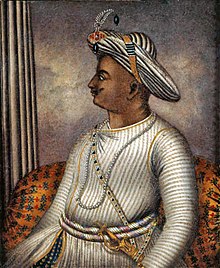
Tipu Sultan ( Urdu:ٹیپو سلطان, Kannada : ಟಿಪ್ಪು ಸುಲ್ತಾನ್ ) (20 November 1750 – 4 May 1799), (Sayyid walShareef Sultan Fateh Ali Khan Sahab Tipu[2]) also known as the Tiger of Mysore, and Tipu Sahib,[3] was a ruler of the Kingdom of Mysore. He was the eldest son of Sultan Hyder Ali of Mysore.[4] Tipu introduced a number of administrative innovations during his rule, including his coinage, a new Mauludi lunisolar calendar,[5] and a new land revenue system that initiated the growth of the Mysore silk industry.[6] Tipu expanded the iron-cased Mysorean rockets and wrote the military manual Fathul Mujahidin. He is considered a pioneer in the use of rocket artillery.[7] Sultan deployed the rockets against advances of British forces and their allies in 1792 and 1799 Siege of Srirangapatna.
Napoleon, the French commander-in-chief who later became emperor, sought an alliance with Tipu. In alliance with the French in their struggle with the British, and in Mysore's struggles with other surrounding powers, both Tipu and his father used their French-trained army[8] against the Marathas, Sira, and rulers of Malabar, Kodagu, Bednore, Carnatic, and Travancore. During Tipu's childhood, his father rose to take power in Mysore, and upon his father's death in 1782, Tipu succeeded to a large kingdom bordered by the Krishna River in the north, the Eastern Ghats in the east, and the Arabian Sea in the west.[9] He won important victories against the British in the Second Anglo-Mysore War and negotiated the 1784 Treaty of Mangalore with them after his father Hyder Ali suddenly died from cancer in December 1782 during the Second Anglo-Mysore War.
Tipu engaged in expansionist attacks against his neighbors. He remained an implacable enemy of the British East India Company, bringing them into renewed conflict with his attack on British-allied Travancore in 1789. In the Third Anglo-Mysore War, Tipu was forced into the humiliating Treaty of Seringapatam, losing a number of previously conquered territories, including Malabar and Mangalore. He sent emissaries to foreign states, including the Ottoman Turkey, Afghanistan, and France, in an attempt to rally opposition to the British. In the Fourth Anglo-Mysore War, the forces of the British East India Company, supported by the Marathas and the Nizam of Hyderabad, defeated Tipu and he was killed on 4 May 1799 while defending his fort of Srirangapatna.

Great blog, Thanks.
ReplyDeleteHe is a man from Jannah , Angels of Allah, KHALID BIN WALID TAKES POISON, The Supplication of Musa, Who is ad-Dayuth?, Ask Allah for everything, True Story of Prophet Yunus, learn quran online, learn quran online uk, quran teacher online,
quran teacher needed, need quran teacher online